SKY130 analog blocks
Why
Analog design is usually taught as rules of thumb: pick a width, simulate, adjust, repeat. Measuring how the transistors actually behave first, and sizing from that data, replaces the guessing. Then the design has to hold across manufacturing variation and temperature, or it is not a design.
How
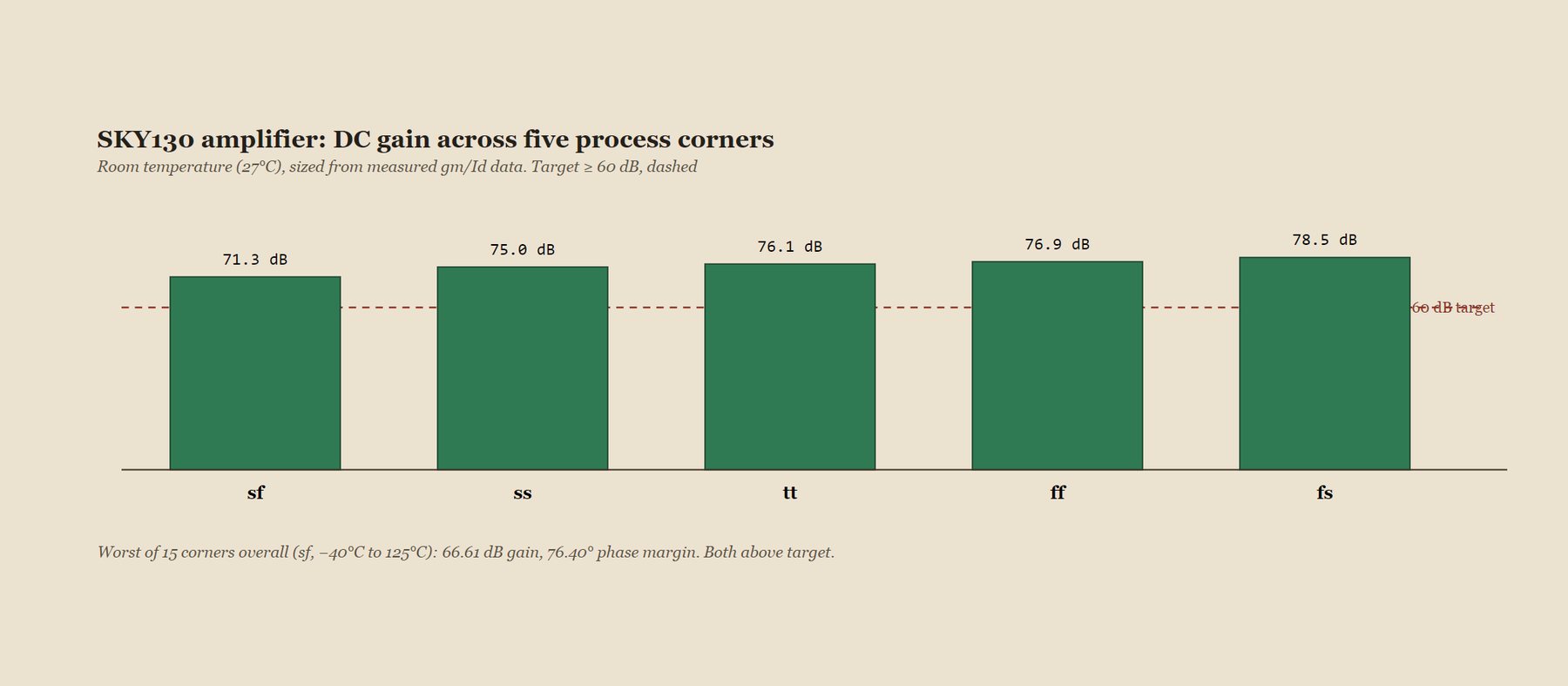
First I built a tool that sweeps a transistor across its operating points on an open-source 130 nm process and records how it behaves. Then I used that data to size a two-stage amplifier and a voltage regulator, and checked both across fifteen combinations of process and temperature and three hundred random mismatch samples.
What came out
Gain and phase margin held at every corner. Bandwidth fell short of its target at the worst corner, and that is recorded rather than tuned away.
What broke
The first amplifier sat at the wrong output voltage because one transistor was mirroring current from the wrong place; a textbook ratio fixed it. The regulator was first wired with its feedback on the wrong input, which made the loop push the wrong way. Three of my measurements were also wrong before they were right, including one that reported phase in radians while I read it as degrees. And the process kit itself has two traps that fail silently, both documented in the repo so nobody else loses the afternoon.